100 DAYS OF IMPACT: How Prof. Sikiru Abayomi Biliaminu Is Giving UITH a New Sense of Purpose

By any measure, the first 100 days of a hospital administrator are a critical test of leadership. At the University of Ilorin Teaching Hospital (UITH), Prof. Sikiru Abayomi Biliaminu has used that period to demonstrate that purposeful leadership is not necessarily about grand pronouncements, but about identifying pressing needs, taking practical steps and delivering measurable interventions.
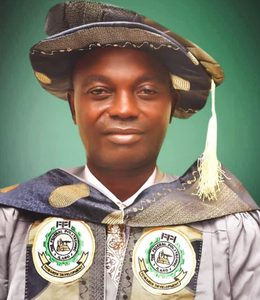
When Prof. Sikiru Abayomi Biliaminu assumed office as Acting Chief Medical Director of UITH, he did not come into an unfamiliar environment.
He came into an institution where he had spent more than two decades building a career as a clinician, academic, researcher, mentor and administrator; that institutional knowledge matters.Since joining UITH in 2002 as a Registrar in the Department of Chemical Pathology and Immunology, Prof. Biliaminu has risen through the ranks – from Chief Resident and Senior Registrar to Hospital Consultant, Honorary Consultant, Head of Department and ultimately Professor of Chemical Pathology.Over the years, he has also occupied critical leadership positions within the institution, including Deputy Chairman and substantive Chairman of the Medical Advisory Committee.
Between August 2023 and February 2026, he additionally served as Acting Chief Medical Director for more than 180 days across different periods when the substantive CMD was unavailable.
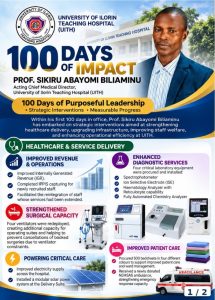
His current tenure, therefore, represents not the beginning of his relationship with UITH, but another chapter in a long history of service to the institution.100 DAYS, AND THE RESULTS ARE BEGINNING TO SHOWThe significance of Prof. Biliaminu’s first 100 days lies largely in the breadth of interventions recorded across different areas of hospital operations.
From revenue generation and electricity supply to laboratory services, emergency response, surgical capacity, staff welfare, security and infrastructure, the administration has pursued interventions touching several aspects of the hospital’s daily operations.
One of the notable areas is laboratory diagnostics, where four critical pieces of equipment have been procured and installed: a Spectrophotometer, Ion Selective Electrode (ISE), Haematology Analyzer with Reticulocyte capability, and Fully Automated Chemistry Analyzer.For a teaching hospital, diagnostic capacity is fundamental.
Better equipment means greater capacity to support accurate and timely investigations, strengthen clinical decision-making and improve the quality of services available to patients.The administration has also recorded interventions in power supply, including the installation of a modular solar power system at the Delivery Suite.
In an environment where reliable electricity is essential to the continuity of critical healthcare services, particularly maternal and newborn care, the intervention represents a practical investment in service delivery.STRENGTHENING SURGICAL AND EMERGENCY CAPACITYHealthcare leadership is ultimately measured by its impact on patients.In the area of surgical services, four ventilators were redeployed to create additional capacity for operating suites.
This intervention is particularly significant because equipment constraints can have a direct effect on scheduled procedures and patient waiting times.Similarly, UITH has received a newly donated petrol/CNG-powered NEMSAS ambulance, strengthening its emergency response and patient transportation capacity.
The Accident and Emergency Unit has also received attention, with renovation work commenced on its front section.These interventions point to an administration paying attention not only to the clinical aspects of healthcare but also to the systems and infrastructure that support them.FROM PATIENT COMFORT TO HOSPITAL ENVIRONMENTSometimes, meaningful improvements in healthcare are found in the details.
The provision of 500 bedsheets in four different colours may appear modest when compared with major infrastructure projects, but such interventions contribute to ward management, patient comfort and the general standard of the hospital environment.
Beyond this, renovation works have been undertaken across various wards and sections of the hospital, while new entrance and exit doors have been provided at designated locations.An entrance into the schools within the school complex has also been constructed to improve access and movement.
The administration has equally commenced the installation of solar-powered security lamps, an intervention designed to improve visibility and security within the hospital environment.Taken together, these measures reflect an understanding that healthcare delivery extends beyond doctors, nurses and medical equipment.
The physical environment in which care is provided also matters.PEOPLE REMAIN AT THE CENTREPerhaps equally important is the attention given to the hospital’s workforce.
The completion of the IPPIS capturing process for newly recruited staff and efforts to facilitate the reintegration of staff whose services had been extended are significant administrative steps aimed at supporting workforce stability and continuity.
This is particularly important in a teaching hospital, where the quality of healthcare delivery is inseparable from the availability, motivation and effective deployment of its human resources.THE ADVANTAGE OF EXPERIENCEProf. Biliaminu’s 100-day record cannot be completely separated from his long experience within UITH.
With more than 165 research publications in local and international journals and contributions spanning areas including endocrinology, chemical pathology, assisted reproductive medicine and clinical embryology, his career combines academic scholarship with practical healthcare experience.His specialized training in India also contributed to the development of UITH’s Assisted Reproductive Unit, while his years of postgraduate supervision and mentorship have helped produce medical professionals now serving in different parts of Nigeria.
This combination of clinical experience, academic exposure and institutional knowledge provides important context for understanding his approach to leadership.He knows the system from within. He knows its strengths, understands its challenges and has experienced its demands at different levels of responsibility.A LEADERSHIP AGENDA BUILT AROUND IMPROVEMENTThe challenges confronting teaching hospitals in Nigeria are well known: infrastructure deficits, funding pressures, workforce requirements, equipment needs and the increasing demand for quality and accessible healthcare. No single administration can resolve all of these challenges within 100 days.
But 100 days can reveal direction and prospects. At UITH, the interventions recorded under Prof. Biliaminu point to a leadership agenda focused on strengthening the institution’s operational foundation while improving the environment in which healthcare is delivered.Improved revenue generation. More reliable power interventions.
Stronger laboratory capacity. Additional surgical support. Emergency response capacity. Staff integration. Security improvements. Renovation. Better access and patient-care materials.
These are not isolated interventions. Collectively, they represent a series of steps directed at different pressure points within the institution.100 DAYS IS ONLY THE BEGINNINGThe real measure of these interventions will ultimately be their sustainability and long-term impact on patients, staff and the institution.
That is why the first 100 days should not be viewed simply as a celebration of what has been achieved, but as a foundation for what comes next.For Prof. Sikiru Abayomi Biliaminu, the opportunity now is to consolidate these gains, deepen ongoing reforms and translate early momentum into lasting institutional improvements.
His first 100 days have demonstrated activity, direction and a willingness to tackle practical challenges. The journey ahead will undoubtedly present bigger demands.But if the first 100 days are anything to go by, UITH has entered this phase with a leadership approach anchored in experience, institutional knowledge and purposeful intervention.
One hundred days may be a short period in the life of a major teaching hospital. But when leadership is measured by purposeful action, even 100 days can leave a visible footprint. At UITH, that footprint is increasingly taking shape.*Signed:*UITH Corporate Affairs Unit.