
Akwa Ibom Retains Nigeria’s Cleanest State Title for Ninth Consecutive Year
…Enugu, Cross River rank second and third as Abia records significant improvement in 2026 environmental assessment
Akwa Ibom State has retained its position as Nigeria’s cleanest state for the ninth consecutive year, scoring 82 per cent in the 2026 State of the Nigerian Environment (STONE) Report released by Clean-up Nigeria (CUN).
The report, tagged STONE UNLEASHED 2026, ranked Enugu State second with 68 per cent, while Cross River State emerged third with 66 per cent. Abia State also recorded significant improvement, moving to sixth position nationally.
The findings were announced by Clean-up Nigeria, an international non-governmental organisation with Special Consultative Status with the United Nations Economic and Social Council (ECOSOC), as part of its annual assessment of environmental cleanliness and sanitation across the country.
According to the report, the assessment combines satellite imagery, physical verification, public opinion surveys and environmental performance monitoring to evaluate the cleanliness and sanitation standards of states and major cities.
The 2026 assessment revealed that 18 states recorded cleanliness scores above 40 per cent, compared with nine states in the 2025 assessment, indicating an improvement in environmental performance across several parts of the country.
Nine cities were also identified as having attained notable cleanliness standards.
They include Abuja, Uyo, Umuahia, Bauchi, Enugu, Jos, Victoria Island, Calabar and Abakaliki.
Despite the recorded improvements, the report estimated that approximately 181.2 million Nigerians were living in unclean environments in 2026, compared with 187.2 million in 2025, out of an estimated national population of 240 million.
It further disclosed that reported hygiene and sanitation practices improved across 24 states and the Federal Capital Territory, rising from 36 per cent in 2025 to 42 per cent in 2026.
However, the report raised concerns over the increasing incidence and prevalence measure for sanitation-related diseases, which rose from 43 per cent in 2025 to 47 per cent in 2026.
It also identified continued dependence on open dumping across most states, noting that only five locations had sanitary landfills.
On waste management, the report observed a decline in the activities of informal-sector recycling and reuse enterprises, from 21 per cent in 2024 to 18 per cent in 2026.
The Nigeria Cleanliness Performance Index, which forms part of the annual STONE report, assesses states using five major indicators: street and road cleanliness, waste management services, vegetation and drainage control, public opinion, and knowledge, attitude and practice of hygiene and sanitation.
The indicators account for 30 per cent, 30 per cent, 15 per cent, 10 per cent and 15 per cent respectively.
Clean-up Nigeria explained that approximately 80 per cent of the assessment was based on monthly satellite imagery and environmental observations, while the remaining 20 per cent came from quarterly physical verification exercises conducted by a 15-member National Technical Study Group led by Professor Solomon Balogun.
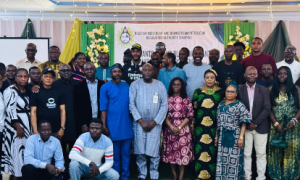
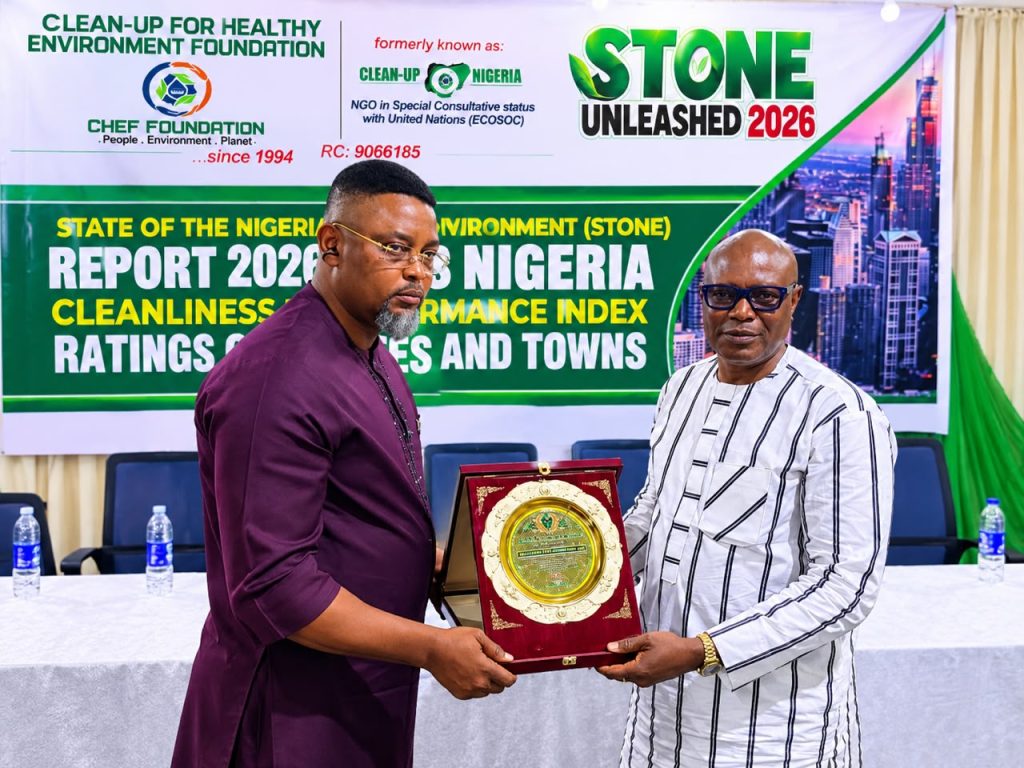
As part of the recognition, Akwa Ibom State received the STONE 2026 Cleanest State in Nigeria Award and Green Crystal Prize for its ninth consecutive victory.
A major highlight of the event was the presentation of the STONE 2026 Cleanest State in Nigeria Award and Green Crystal Prize to Akwa Ibom State in recognition of its outstanding environmental performance and its emergence as Nigeria’s cleanest state for the ninth consecutive year.
The award further reinforces the state’s position as a leading example of environmental cleanliness, effective sanitation management and sustained commitment to a healthier environment.
Enugu and Cross River will also be recognised for their second- and third-place performances, while Abia State will receive a special Green Crystal Prize for its outstanding improvement in environmental cleanliness.
The Chairman of the Akwa Ibom State Environmental Protection and Waste Management Agency, Obong Prince Ikim, is also scheduled to receive an award for environmental leadership.
Similarly, Akwa Ibom State Governor, Pastor Umo Eno, is to receive the Green Crystal Prize for Nigeria’s Best Government Environmental Project 2026 in recognition of the Arise Palm Resort project.
The organisation said the awards were designed to encourage healthy competition, environmental innovation, accountability and sustained improvements in sanitation and waste management across the country.
In another development, Clean-up Nigeria announced plans to transition to a new organisational identity, Clean-up for Healthy Environment Foundation (CHEF Foundation), effective January 1, 2027.
The organisation, established in 1994, said the transition would enable it to expand its environmental, public health and climate-resilience programmes across Nigeria.
It explained that both names would be used interchangeably during a two-year transition period covering 2027 and 2028, while CHEF Foundation would become its principal operating name from January 1, 2029.
Under its proposed five-year strategic plan covering 2027 to 2031, the foundation intends to establish a national headquarters in Abuja, six geopolitical regional offices and partnerships with up to 250 local non-governmental organisations, with progressive engagement across all 774 local government areas.
Its priority areas will include clean water, integrated waste management, recycling, environmental sanitation, climate resilience, flood-risk reduction, ecological restoration and public-health awareness.
Speaking on the findings, the National Coordinator of Clean-up Nigeria and Secretary of the National Technical Study Group, Prince Ene Baba Owoh Jr., said the report was designed to promote accountability and encourage governments to translate environmental commitments into measurable action.
He said: “STONE UNLEASHED 2026 is more than an environmental report. It is a national accountability instrument designed to move Nigeria from environmental promises to measurable environmental action.
“Our objective is not simply to rank states or identify winners. We want governments to understand their environmental performance, identify their weaknesses, learn from successful states and invest in practical solutions that will improve the health and living conditions of Nigerians.”
Owoh commended Akwa Ibom for sustaining its leading position and described Abia’s improvement as evidence that environmental progress was achievable through leadership, institutional commitment and public participation.
He also called on the Federal Government, state governments and local councils to increase investment in sanitation and waste management, with the report recommending at least a 25 per cent increase in funding for the sector.
Other recommendations include modernising waste collection and disposal systems, investing in sanitary landfills and recycling infrastructure, improving the welfare of sanitation workers, strengthening public hygiene education and ensuring regular drainage maintenance.
The organisation also urged greater collaboration among government institutions, corporate organisations, development partners and citizens, stressing that environmental cleanliness remained a collective responsibility.
Clean-up Nigeria said the findings were intended to contribute to national discussions on sustainable cities, public health, climate resilience, environmental governance and the circular economy.